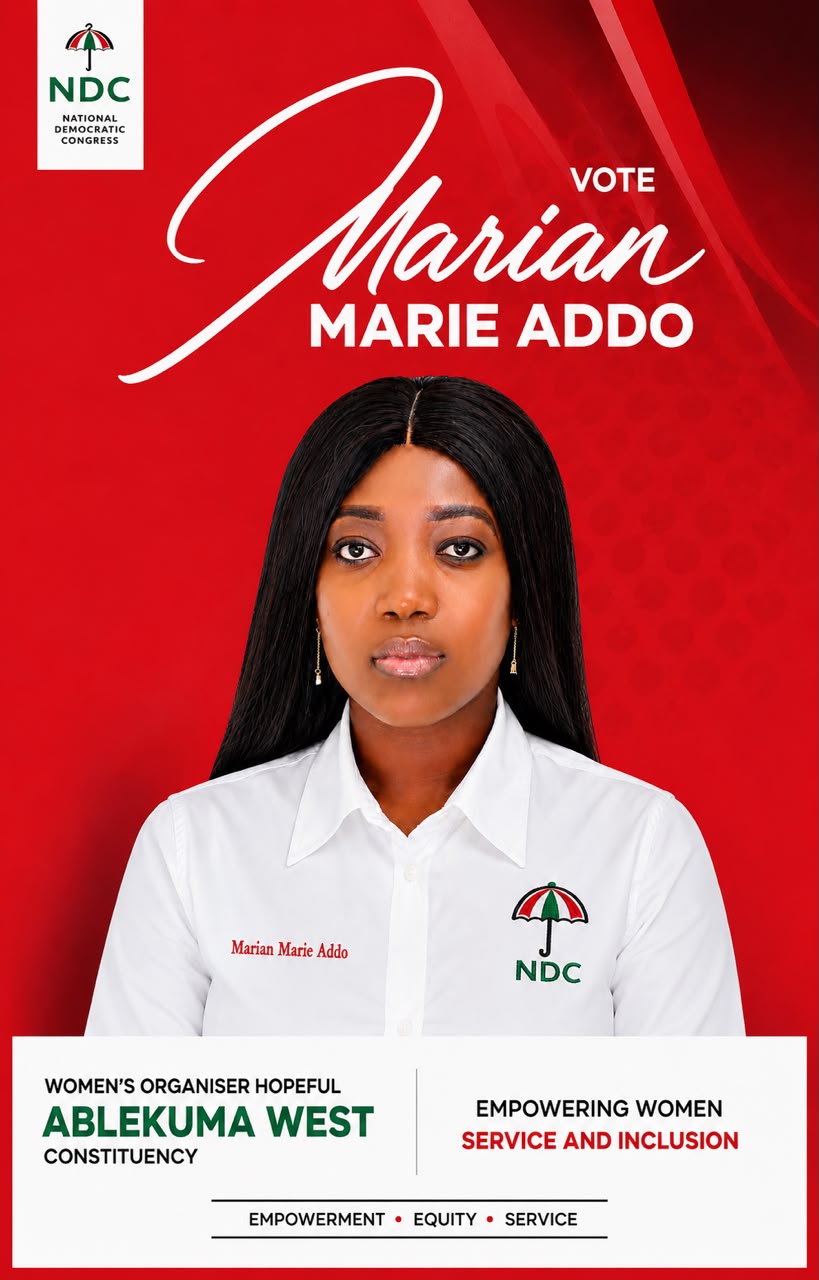
NDC’s HON. MARIAN MARIE ADDO RECORDS STRONG APPROVAL IN ABLEKUMA WEST DELEGATE SURVEY AS THE NEXT CONSTITUENCY’S WOMEN ORGANIZER
In every community, there comes a moment when political leadership is judged not merely by loyalty, familiarity or the strength of relationships, but by the visible difference it makes in people’s lives. For many constituents and party delegates, the question increasingly becomes simple: What has leadership done, and what more can it do?
It is within this context that a recent survey conducted by the Political Researchers Forum has placed performance, competence and community interventions at the centre of the conversation ahead of the NDC’s internal elections in Ablekuma West.
The survey, conducted ahead of the filing of nominations for the various positions, examined approval levels among selected categories of delegates in relation to some key positions such as the Chairmanship, Secretary, Women’s Organizer and Youth Organizer.
The first position surveyed was in relation to Hon. Vicentia Banini and Hon. Marian Marie Addo, who are contesting for the position of Constituency Women’s Organizer.According to the survey data presented, Marian Marie Addo recorded higher approval among all four categories of respondents surveyed and is tipped to be the eventual winner, all things being equal.
Among 23 constituency executives interviewed, 16 respondents approved of Marie, representing approximately 70%, while seven, or about 30%, did not approve of her. Among the 13 Assembly Members surveyed, eight approved of Marie, representing approximately 62%, compared with five respondents, or 38%, who did not.
The survey also covered 11 Ward Coordinators. Seven respondents, representing approximately 64%, approved of Marie, while four, representing approximately 36%, did not. The largest group surveyed was the 233 Branch Women Organizers. Of these, 168 respondents, representing approximately 72%, approved of Marie, while 65, representing approximately 28%, did not.
Beyond the numbers: what appears to be driving the conversation?
The survey narrative suggests that the conversation among respondents is not limited to traditional campaign visibility or door-to-door engagement. It points towards a broader consideration of performance, competence, consistency and tangible community interventions.
Marie’s supporters and respondents cited several interventions associated with her public activities. These include the donation of 11 industrial ovens to the various wards to empower women organizers economically, provision of mattresses, provisions, stationery and other materials to 120 students entering Senior High School, donation of assorted home appliances to women aged 50 years and above, and the establishment of the Ablekuma West Women’s Wing Welfare Fund reportedly launched with seed capital of GH¢200,000.
Supporters also point to her broader engagement with residents and describe her as a community development advocate whose activities extend beyond conventional campaign periods. These interventions form part of a wider question increasingly confronting political organisations at the grassroots: Should internal leadership choices be determined primarily by loyalty and longstanding relationships, or should measurable service, competence and community impact also play a significant role?
There is no single answer to that question, and delegates ultimately make their choices based on their own assessment of candidates. Nevertheless, the survey provides an indication that performance and visible interventions have become part of the criteria being discussed by sections of the constituency’s delegates.
The significance of grassroots welfare to NDC’s Reset Agenda
Women’s welfare has traditionally been an important component of grassroots political organisation. Beyond electoral mobilisation, women’s groups often serve as important networks for social support, community advocacy and household-level interventions. The establishment of a dedicated welfare fund therefore represents a potentially significant institutional approach to addressing welfare needs, particularly if such a fund is transparently managed, sustainably financed and accessible to beneficiaries.
Similarly, educational assistance to young people can have consequences beyond the immediate beneficiaries. For families struggling with the cost of school-related materials, relatively modest interventions can reduce some of the financial pressure associated with the transition to Senior High School.
From loyalty to Development
Ultimately, the Ablekuma West contest provides another opportunity for a broader conversation about the meaning of grassroots leadership. Political loyalty remains an important element of party organisation. Parties depend on committed members, organisers and activists to build structures and sustain political activity. But loyalty and development need not be mutually exclusive.
The more important question may be how party members reconcile loyalty with accountability, competence, service and the capacity to deliver for the people they seek to represent.
The figures presented by the Young Policy Initiates’ research crew suggest that, among the groups surveyed, Marian Marie Addo has generated significant approval and is the preferred choice of most respondents for the position of the Women Organizer.
What the survey nevertheless highlight is a conversation worth having beyond personalities grassroots leadership must ultimately be connected to the need of the poeple .
As the internal contest progresses, the emphasis on development, welfare, education, women’s empowerment and community service could provide delegates with substantive issues to consider alongside party loyalty, personal relationships and campaign history.
In the end, internal democracy is not only about choosing people we like. It is also about determining what kind of leadership the constituency wants to reward, sustain and hold accountable.